
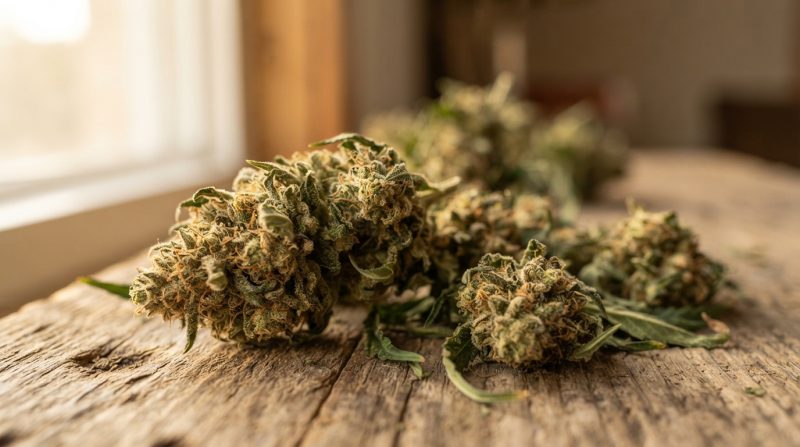
THCA flower contains high concentrations of tetrahydrocannabinolic acid, the naturally occurring precursor to THC found in raw cannabis. Understanding what is THCA flower also requires knowing what happens when it is exposed to heat. Through a process called decarboxylation, THCA converts into THC, producing the psychoactive effects commonly associated with cannabis.
What THCA Flower Actually Is and How It Works
THCA forms in the trichomes of cannabis plants through the biosynthesis of CBGA, often called the “mother cannabinoid,” and is present in high concentrations in freshly harvested flower. Only through decarboxylation, a process involving heat or time, does THCA convert into THC, the compound responsible for cannabis’ psychoactive effects.
THCA flower looks, smells, and feels like regular cannabis but is sold legally under hemp rules because it contains under 0.3% Delta-9 THC before heating. The act of smoking or vaping THCA initiates decarboxylation, converting it into Delta-9 THC, the compound responsible for the euphoric effects associated with marijuana. This is what makes THCA flower psychoactive when heated.
Here is how THCA flower compares to related products:
|
Product |
Psychoactive Raw |
Source |
How Produced |
|---|---|---|---|
|
THCA Flower |
No |
Hemp plant (natural) |
Selectively bred, early harvest |
|
CBD Flower |
No |
Hemp plant (natural) |
Standard hemp cultivation |
|
Delta-8 Flower |
No (trace) |
Hemp (infused) |
CBD converted, sprayed onto flower |
|
Dispensary Cannabis |
Yes |
Marijuana plant |
Licensed cannabis cultivation |
Potential Benefits and Known Risks
THCA is a non-psychoactive, naturally occurring cannabinoid found in raw cannabis flower before heating. It has garnered attention for its potential medicinal uses, such as reducing inflammation, stimulating appetite, alleviating nausea, providing relief for seizure disorders, and improving chronic pain. According to research reviewed by recovered.org, these applications remain under active clinical study and should not be treated as established medical guidance.
Preclinical research points to anti-inflammatory and neuroprotective properties, but human clinical data remains limited. Consumers should consult a healthcare professional before using THCA products for any health purpose.
Risks worth understanding before purchasing:
-
Psychoactive effect upon use. Once you apply heat to consume THCA flower, you are converting it into Delta-9 THC and experiencing effects comparable to high-grade marijuana. This creates an unusual situation where the product’s legal status depends on its chemical state at point of sale rather than its practical use or effects.
-
Testing limitations. Standard field tests cannot reliably distinguish THCA flower from marijuana. Both will often trigger a positive result.
-
Product quality variance. THCA is considered non-toxic, but risks arise when products are not tested or are consumed in excess.
-
Drug testing. Because THCA converts to Delta-9 THC upon consumption, standard urine drug screens will likely return a positive result.
Legal Status in the USA: What Buyers Must Know in 2026
THCA flower is legal at the federal level as of mid-2026. That legal standing rests on the Delta-9 THC testing standard from the 2018 Farm Bill, which THCA flower passes in its raw form.
However, the landscape is shifting rapidly. Amended federal law now defines hemp to include cannabis and cannabis derivatives “with a total THC concentration (including THCA) of not more than 0.3 percent on a dry weight basis.” Products that many consumers came to know as “hemp-derived” intoxicants, including THCA flower, are now excluded as legal hemp when the new law takes effect in November 2026.
At the state level, the picture is equally complex:
-
Idaho, Kansas, Nebraska, and Tennessee have effectively banned THCA flower.
-
Several states have introduced legislation to address the THCA flower market specifically, either by implementing total THC testing requirements, establishing explicit age restrictions, or banning hemp-derived intoxicating cannabinoids altogether.
-
THCA flower can be legally shipped between states where hemp products are permitted under federal commerce protections. Shipping to a state that has restricted or banned THCA creates legal risk for both the sender and recipient.
Always verify your state’s current laws before purchasing or accepting a shipment.
What to Look for When Buying THCA Flower
Purchasing from a transparent, lab-verified source is the single most important step a buyer can take. Key criteria to evaluate:
-
Certificate of Analysis (COA). Carrying a COA that confirms Delta-9 THC content below the legal threshold is important documentation, particularly when traveling with THCA flower in legal states.
-
Third-party testing. Verify that an independent, accredited lab tested the specific batch, not just the brand’s product line.
-
Cultivation origin. THCA flower is cultivated from selectively bred hemp genetics, harvested at precise maturity windows, and looks identical to traditional marijuana. Knowing where and how the flower was grown matters for both compliance and quality.
-
Hand-trimmed vs. machine-processed. Hand-trimmed flower typically preserves trichome integrity better than machine processing.
Luminate makes it simple to buy THCA online without guessing about quality. Every product starts as hemp-derived THCA, sourced with care and tested before it reaches your door. They grow, harvest, and hand-trim their flower with care, then send it to independent labs for testing before it ships.
Frequently Asked Questions
Does THCA flower get you high? Once you smoke, vape, or bake THCA flower, THCA converts to psychoactive THC, delivering the same high as marijuana. In its raw, unheated form, it is non-psychoactive.
Will THCA flower show up on a drug test? Yes. Because consumption converts THCA to Delta-9 THC, standard drug screenings will detect it. This applies regardless of the product’s hemp-legal status at point of sale.
Is THCA flower the same as CBD flower? No. CBD flower offers no intoxication, while THCA flower produces full cannabis effects once heated. They are chemically and experientially distinct products.
How long will THCA flower remain federally legal? Legislation signed in late 2025 would effectively ban most THCA flower products if its total THC enforcement standard takes effect in November 2026. Industry legal challenges and potential Farm Bill revisions could delay, modify, or block that outcome. Buyers should monitor federal and state developments closely.
For consumers seeking verified, lab-tested THCA hemp flower, Luminate offers third-party COAs on every product, hand-trimmed flower, and federally compliant hemp sourced from farms across the country. Confirm your state’s current laws before ordering, and always purchase from sources that publish full batch-level test results.